 Watashi Games

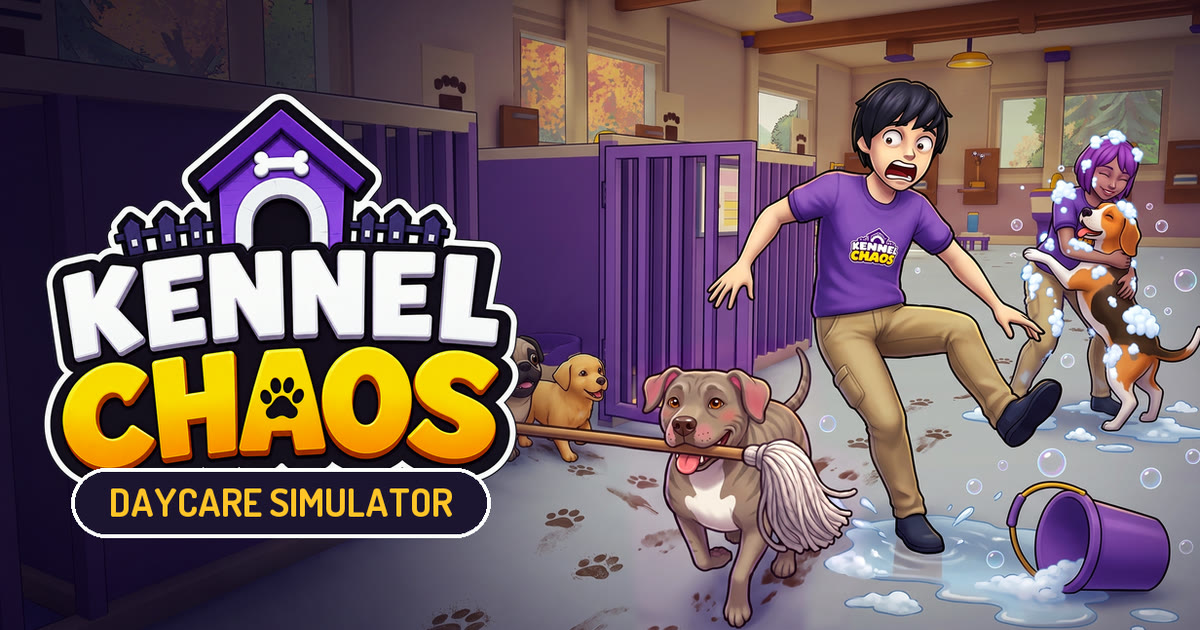
The Steam page is live
Kennel Chaos now has a Steam page, which means you can wishlist the thing we have been quietly building. It is a co-op simulator about running a dog daycare: 1 to 8 players, twenty-one breeds, and a working day that is entirely manageable right up until the moment it is not.
The pitch is short. A dog daycare. Your friends. It goes badly. There is no hiring screen and no staff menu — you are the staff. Somebody has to carry the beagle, somebody has to scoop the corridor, and if nobody does either for four minutes you will spend the rest of the shift finding out why that was a mistake.
If that sounds like your kind of afternoon, the wishlist button is the single most useful thing you can click. More on why at the bottom.
You are the staff, not the manager
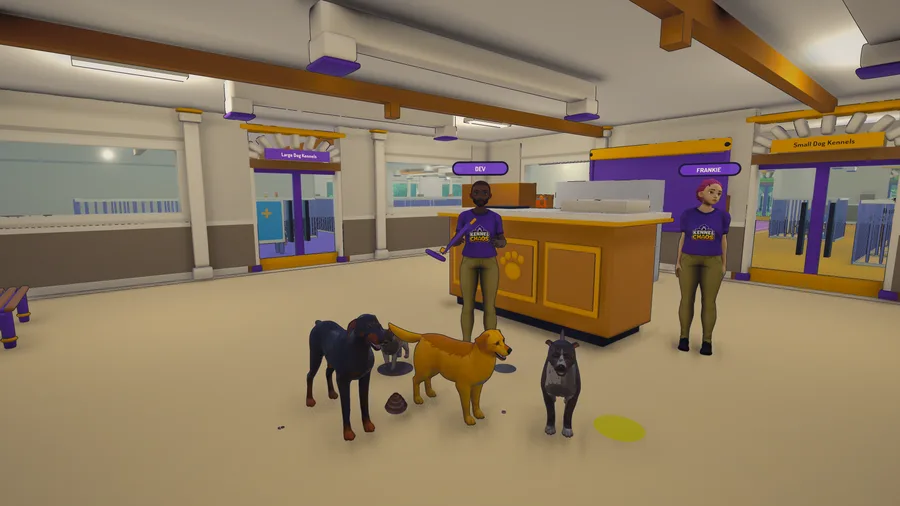
A lot of business sims hand you a spreadsheet and a hiring budget, and the game becomes choosing who does the work. Kennel Chaos goes the other way. Every job in the building is performed by a player, in first person, with their hands.
Check dogs in at the desk and read their care card. Prepare food and get it into the right bowl. Give medication to the dog that needs it, not the one standing nearest. Rotate animals between kennels and the play yard. Run potty breaks. Clip nails. Bath the ones that need bathing, and then bath the one that just rolled in something. Break up a scuffle before it becomes a fight. Get every dog back to the right owner, on time, in the condition their card promised.
Upgrades make you better at working — a bigger wash station, a better tool rack, more space to move — rather than doing the work for you. The moment a game automates its own main verb, the fun goes with it.
Twenty-one breeds, twenty-one problems
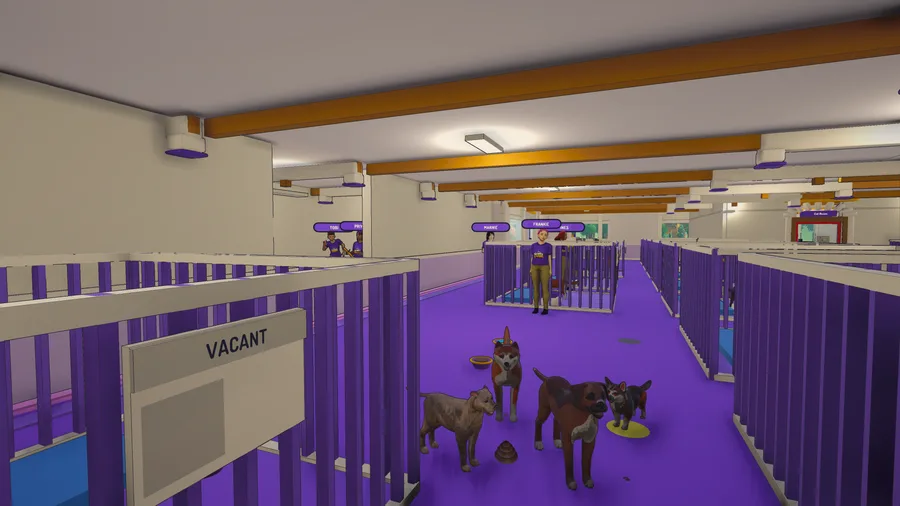
The dogs are the difficulty curve. Twenty-one breeds, and the breed is not a skin — each one arrives with habits that change how your shift goes.
The Escape Artist is testing every gate in the building right now, quietly, and she will find the one you forgot to latch. The Sneaky Pooper waits until you are facing the other way and then picks a corner you will not think to check for ten minutes. The Shaker is perfectly calm in the tub and returns the entire bath to the floor the second she is out and standing next to you. Zoomies has no brakes and no opinion about what is in the way, including you and the bowls you just filled. Rolls In It has already found the mess you were walking over to clean. The Poop Eater solves that same problem in the worst way available, and then goes to say hello to a customer.
Which is why you end up learning them by name. You are not managing eleven units, you are managing Bailey, who is fine, and Max, who cannot be left near Charlie.
You can carry one thing
The rule that shapes everything else: you can carry a dog, or you can carry a tool. Never both.
Tools live on the racks you bought and placed, so where you put those racks stops being decoration and becomes a decision you will think about a great deal — usually while jogging the length of the building holding a wriggling beagle, past the mop you now cannot pick up.
In co-op it turns into an actual conversation. One player carries, one player cleans, one player is at the desk, and the plan holds for about ten minutes before three things happen at once and everybody is suddenly holding the wrong object.
How a small mess becomes a Code Brown
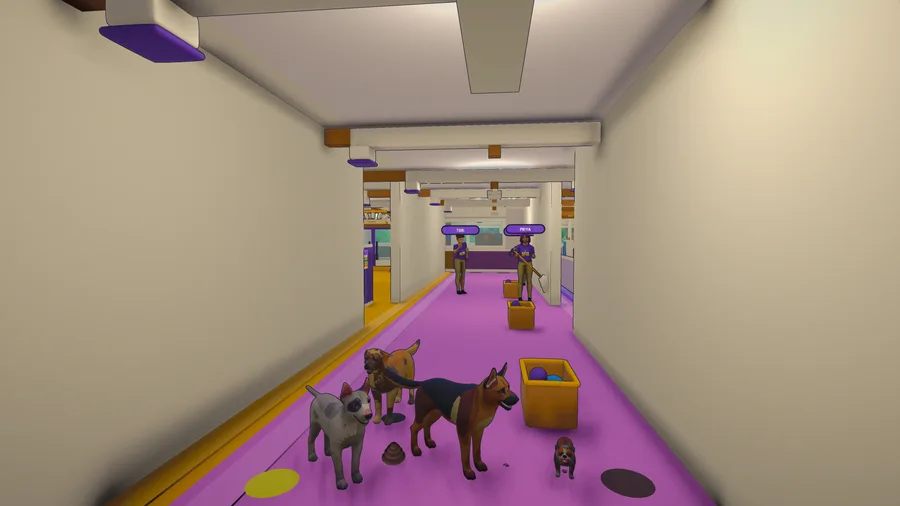
Mess has four states, and it moves between them on its own: fresh, stepped in, tracked, dried.
A fresh poop takes two seconds to scoop. Leave it and a dog walks through it, and now there are paw prints down the corridor. Leave those and they dry on, and dried mess needs a scrub rather than a wipe. Meanwhile the dog that walked through it needs a bath it did not need five minutes ago, the floor rating is dropping, and its owner is arriving early.
Almost nothing in Kennel Chaos ends your run outright. Mistakes make more work instead, and the work compounds. That is the whole comedy engine: nobody loses to a failure screen, everybody loses to the third thing that went wrong while they were fixing the second.
Build the place, then pay for it
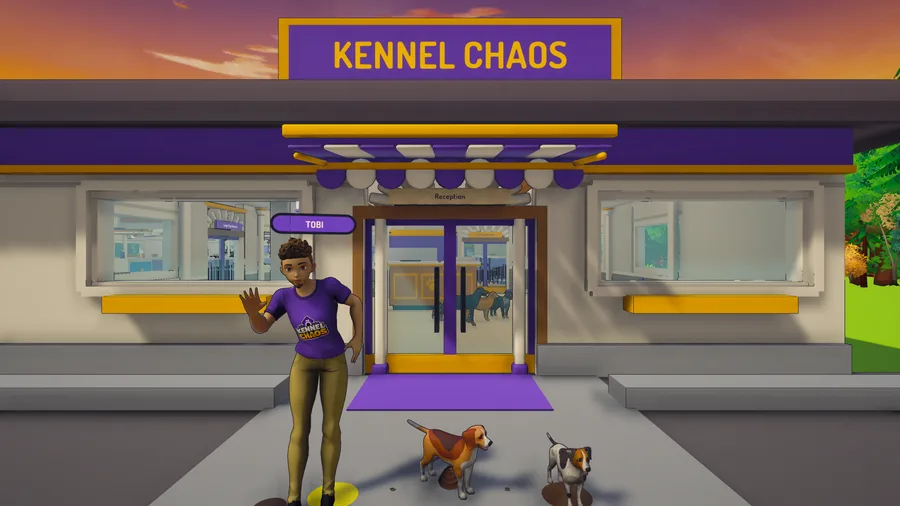
You start with an empty building and a small pile of money. Runs, tubs, grooming tables, food prep, play equipment, an outdoor yard with a paddling pool — you buy it, you place it, and you live with the layout you chose. Paint the walls. Hang wallpaper. Put a clock up so somebody can see how far behind you are.
Then you open the doors and find out which of those decisions were stupid. Takings come in, upkeep goes out, and your star rating moves on whether every dog actually got what its care card promised. Spend what is left before bed, and do it again tomorrow with more dogs — because the business is always happy to sell you more work than you can do.
That is the greed loop, and it is where most disasters start. Four more bookings looks like free money right up until two of them are on medication and one of them is the Escape Artist.
Solo works. Co-op is louder.
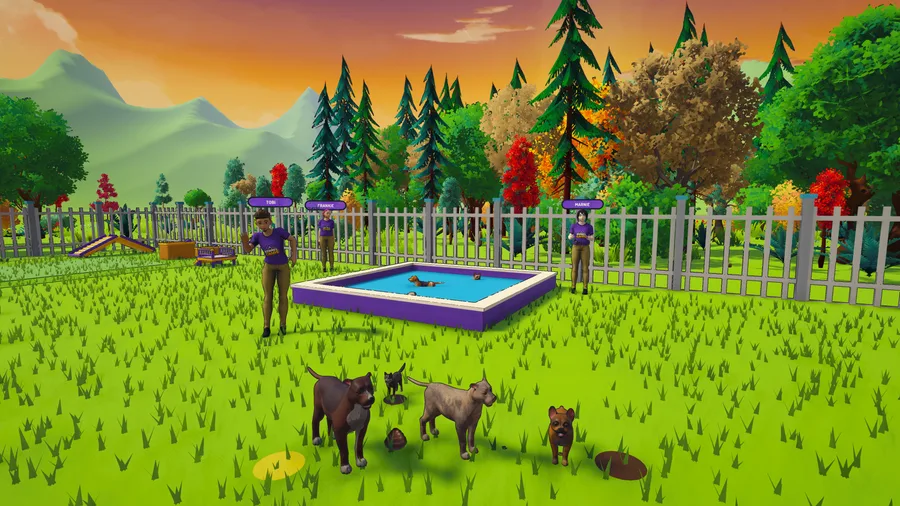
Kennel Chaos is fully playable on your own. Dog counts, timings and workload scale with how many of you there are, so a solo shift is a real game and not a tutorial for the co-op one.
But it is built for a full house. Online co-op runs 1 to 8 players, and the jobs divide naturally — which means so does the blame. Half the fun of a workplace game is hearing somebody across the building shout a dog's name in a tone that tells you exactly what has happened.
Why the wishlist actually matters
Wishlists are not a vanity number. They are close to the only signal Steam has about a game that has not launched yet, and they decide how much of Steam's own surface a small game gets to stand on — Popular Upcoming, the front-page queues, and the email that lands in your inbox on release day.
For a studio our size that is the entire marketing budget. There is no publisher buying placement here; there is a wishlist count and whatever we can make people laugh at.
So: wishlist Kennel Chaos on Steam. It takes one click, it costs nothing, Steam tells you the day it goes live, and you will be first to hear if a demo opens. If you want to follow along while we build it — or argue about which breed is the worst — the Discord is where that happens.