 Watashi Games

The short answer
A physics party game is a multiplayer game where the comedy comes from a physics simulation rather than from written jokes, and where rounds are short enough that losing badly is funny instead of annoying. The simulation is not there for realism. It is there because a rigid-body solver will humiliate you in ways no designer could have scripted.
That is the whole genre in one sentence, and it is worth being precise about it, because the three words are doing separate work. Physics means outcomes are simulated, not animated. Party means it is designed for a group, usually with a low skill floor. Game means there is a goal you can fail at — which matters more than it sounds, because failure is where the laugh lives.
Remove any one of those and you get something else. Physics without the party is a sandbox. Party without the physics is a minigame collection. A goal without the possibility of spectacular failure is just a race.
Why physics and not scripted comedy
Scripted comedy has a hard ceiling in games: everyone eventually sees the same joke, and the second viewing is never as good as the first. A simulation does not have that problem. Nobody wrote the moment where your car lands on its roof, slides forty feet, and crosses the finish line backwards in first place — the solver did, once, and it will never do it exactly that way again.
This is why the genre leans so hard on ragdolls, floppy limbs, unstable vehicles and objects that are just slightly too heavy. Those are all ways of adding controlled unpredictability. The designer sets up the conditions for disaster and then gets out of the way.
It also means the funniest thing that happens in a session is usually something the developers have never seen. That is the mark of a physics party game working properly.
The traits they share
Short rounds. Somewhere between thirty seconds and a few minutes. If a run takes twenty minutes, losing it to a physics accident stops being funny and starts being a waste of your evening.
A low skill floor and a high ceiling of nonsense. Anyone can play in the first minute. Mastery exists, but it is never the point, and a complete beginner can still produce the best moment of the match by accident.
Failure is spectacular and cheap. You need to be able to lose loudly and immediately get another go. Harsh punishment for failure kills the genre dead, because failure is the content.
Everyone can see it happen. This is the one people forget. A physics party game needs shared visibility — spectator views, everyone on the same course, wide camera angles. A joke nobody witnessed did not land.
It reads instantly. Chunky shapes, readable silhouettes, clear colours. If you cannot tell at a glance whose vehicle just detonated, the moment is wasted.
What it is not
Not a physics sandbox. Sandboxes are wonderful and mostly solitary — you build a thing, you admire it, you break it, nobody is keeping score. A party game needs the competitive frame, because the frame is what turns an accident into a story you tell each other afterwards.
Not a simulator. Simulators are trying to be accurate. Physics party games are trying to be funny, and will happily make a wheel twice as bouncy as it should be if that is the better joke. Accuracy is a means here, never a goal.
Not just a party game with physics in it. Plenty of games have a physics engine running. The genre marker is whether the physics is the entertainment, or merely the plumbing underneath a set of designed minigames.
Where the building layer comes in
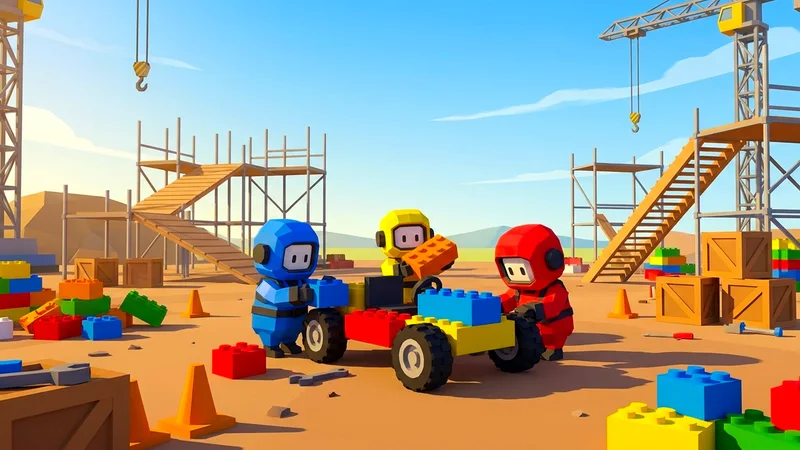
A smaller branch of the genre hands you the construction set as well. Instead of everyone getting the same character or the same kart, you build the thing that is about to fail, and the failure is therefore partly your fault. This changes the comedy in a specific way: it turns an accident into a punchline you set up yourself, three minutes earlier, when you decided six wheels was enough.
It also solves the repetition problem that eventually catches every party game. When the challenge changes — a hill climb, a long jump, a joust — the correct vehicle changes with it, so the interesting decision resets every round rather than settling into one optimal strategy.
That is the corner Jank Yard lives in. Every challenge wants a different contraption, you snap one together out of bricks, and then you find out which parts stay attached. There is exactly one building rule — it needs a seat, because somebody has to drive — and beyond that the game stays out of the way.
How to tell if you like the genre
A reliable test: think about the last time a game glitched in front of you and a friend, and you both immediately said "did you see that". If your instinct in that moment was delight rather than irritation, this genre was built for you.
If your instinct was to file a bug report, you probably want a simulator, and that is an entirely respectable thing to want.
The genre asks for a specific kind of tolerance — for chaos, for losing to something that was nobody's fault, for the best player in the lobby being taken out by a ramp. In exchange it produces moments that no scripted game can, and it produces them for free, forever, because the simulation never runs out of new ways to go wrong.